The Devil in the Shape of a Woman Full Book Review
The Devil in the Shape of a Woman
by Carol Karlsen
Reviewed past Mathew Madden
Salem Witch Trials in History and Literature
An Undergraduate Grade, Academy of Virginia
Bound Semester 2001
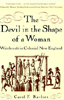
The Devil in the Shape of a Woman past Carol Karlsen (1987) astutely focuses attention upon the female as witch in colonial New England, thus allowing a discussion of broader themes regarding the role and position of women in Puritan society. Karlsen's work, which has been well-received, focuses on the position of accused witches as largely females placed in precarious social and economic positions, frequently considering they stood to inherit, had inherited, or lost an inheritance in property. Karlsen departs from the idea that women accused of witchcraft were boisterous beggars, a depiction "tantamount to blaming the victim" (Nissenbaum) and instead points to these "inheriting women" as existence socially vulnerable in a patriarchal culture.
Karlsen'southward work is not just of historical significance to the Salem outbreak of 1692. In fact, "that year remains something of an anomaly" (Nissenbaum) as one-tertiary of the accused witches so were male compared to less than i-fifth of accusations fabricated otherwise in colonial New England. Instead, Karlsen's written report brings "women strongly back to center phase, locating them in a rich patriarchal matrix that integrates it with class and family." (Nissenbaum). 1 reviewer notes that inside this context, Karlsen offers meaning insights. The offset is a look at the "ambivalent assessment of women within New England's civilization." (Gildrie). Karlsen finds a scenario marked by its time and identify in which women embodied the "Puritan platonic of women as virtuous helpmeets" (Boyer). In an odd duality, women were both the new stewards of God's spiritual leadership on earth, while subservient to a Medieval, misogynist gender role which largely placed their fate at the hands of men.
Secondly, Karlsen focuses attention on the accusers and finds that they were engaged in a "fierce negotiation... about the legitimacy of female discontent, resentment, and anger." (Karlsen; meet Gildrie). Accusations of witchcraft were ofttimes an outlet where this negotiation boiled over into violence, equally men persecuted female person neighbors who threatened an established, only precarious, social order. The crucial thesis on which much of the volume rests is that witchcraft accusations were virtually often made against women who threatened the orderly transfer of land from father to son - a process at best fraught with tension and anxiety and at worst marked past the shift of scarce, valuable backdrop from 1 family to another past way of an intervening woman in a patriarchal inheritance organisation. The possessed girls played a dual part in this "symbolic cultural drama" in which they rebelled against the social role to which they had been predestined at birth past simultaneously acquiescing in that office by resisting the "witch."
If nil else, Karlsen's contempo work proves that in that location is even so room for substantial study and scholarship surrounding witchcraft, gender, and other issues in colonial New England. Ane commentator writes, "Karlsen'southward study is provocative, wide-ranging, accessible, and frank." (Lindholt). Another, that the book's "descriptions and analyses stand on their own as valuable contributions to our knowledge of witch lore and the ambiguous status of women in early on New England." (Gildrie). Paul Boyer and Stephen Nissenbaum, whose Salem Possessed set the standard for social histories of the outbreak in Salem, notice that Karlsen's piece of work is one of "formidable intellectual power" and "a major contribution to the study of New England witchcraft." It places the central role of women equally witches under the microscope and "for the first fourth dimension every bit the subject of systemic analysis" a considerable 300 years after the events transpired. Karlsen's work is required reading for the pupil, scholar, or general reader seeking to understand and interpret the broad pic of colonial witchcraft in New England.
Back to Scholarship
References:
Paul Boyer. Book Review, The Journal of American History. Volume 75, Event 3 (Dec., 1988), 893-894.
Richard Gildrie. Book Review. The American Historical Review. Volume 94, Upshot i (February., 1989), 211-212.
Karlsen, Carol F. The Devil in the Shape of a Woman: Witchcraft in Colonial America.New York: Due west.W. Norton & Co., (1987).
Paul J. Lindholdt. "Crimes of Gender in Puritan America". American Quarterly. Volume 40, Issue 4 (Dec., 1988), 563-568.
Stephen Nissenbaum. Book Review. William and Mary Quarterly Third Series, Book 46, Issue three (Jul., 1989), 593-596.
Source: https://salem.lib.virginia.edu/karlsenrev.html

Post a Comment for "The Devil in the Shape of a Woman Full Book Review"