what leads paleontologists to hypothesize that whales evolved from wolf-like carnivores?
The kickoff thing to notice on this evogram is that hippos are the closest living relatives of whales, but they are not the ancestors of whales. In fact, none of the private animals on the evogram is the direct ancestor of any other, as far every bit nosotros know. That'southward why each of them gets its ain branch on the family tree.
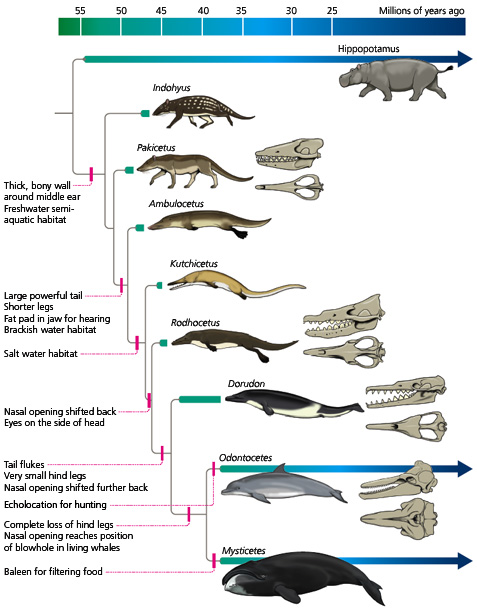
Hippos are large and aquatic, like whales, but the 2 groups evolved those features separately from each other. Nosotros know this because the ancient relatives of hippos called anthracotheres (not shown here) were not large or aquatic. Nor were the ancient relatives of whales that you see pictured on this tree — such equallyPakicetus. Hippos likely evolved from a group of anthracotheres about 15 1000000 years ago, the commencement whales evolved over 50 1000000 years ago, and the ancestors of both these groups were terrestrial.
These first whales, such equallyPakicetus, were typical land animals. They had long skulls and large teeth that could be used for eating meat. From the outside, they don't await much like whales at all. All the same, their skulls — specially in the inner ear region, which is surrounded by a bony wall — strongly resemble those of living whales and are unlike those of whatever other mammal. Often, seemingly minor features provide critical evidence to link animals that are highly specialized for their lifestyles (such as whales) with their less farthermost-looking relatives.
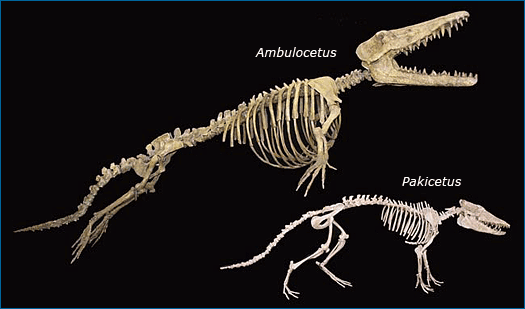
Compared to other early whales, likeIndohyus andPakicetus,Ambulocetus looks like it lived a more aquatic lifestyle. Its legs are shorter, and its hands and feet are enlarged like paddles. Its tail is longer and more than muscular, too. The hypothesis thatAmbulocetus lived an aquatic life is also supported past evidence from stratigraphy —Ambulocetus's fossils were recovered from sediments that probably comprised an aboriginal estuary — and from the isotopes of oxygen in its basic. Animals are what they eat and drink, and saltwater and freshwater have unlike ratios of oxygen isotopes. This means that we can acquire about what sort of h2o an animal drank by studying the isotopes that were incorporated into its bones and teeth as information technology grew. The isotopes evidence thatAmbulocetus likely drank both saltwater and freshwater, which fits perfectly with the idea that these animals lived in estuaries or trophy between freshwater and the open body of water.
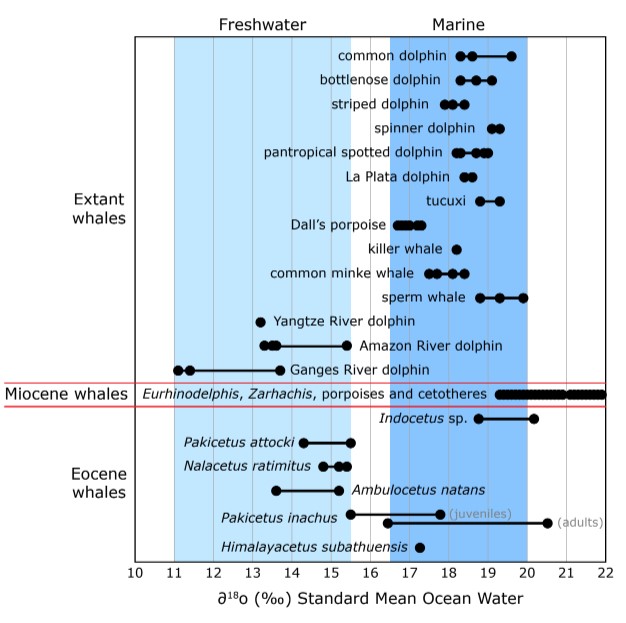
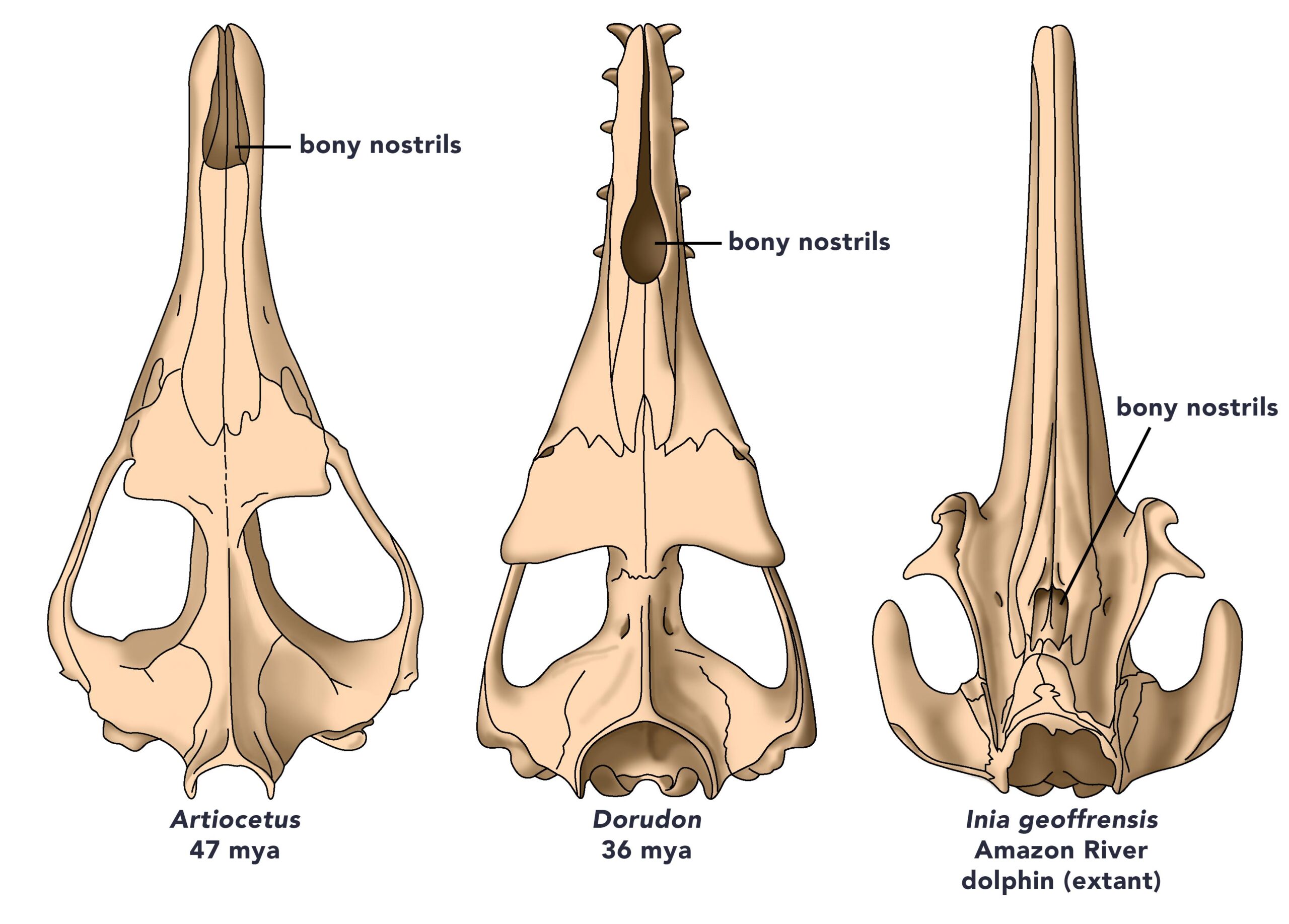
Whales that evolved afterAmbulocetus (Kutchicetus, etc.) prove even higher levels of saltwater oxygen isotopes, indicating that they lived in nearshore marine habitats and were able to beverage saltwater as today's whales can. These animals evolved nostrils positioned further and further back along the snout. This tendency has continued into living whales, which have a "blowhole" (the outside opening to the bony nostrils) located on tiptop of the head to a higher place the eyes.
These more aquatic whales showed other changes that also propose they are closely related to today'south whales. For case, the pelvis had evolved to be much reduced in size and carve up from the backbone. This may reflect the increased apply of the whole vertebral column, including the dorsum and tail, in locomotion. If you spotter footage of dolphins and other whales swimming, you'll notice that their tailfins aren't vertical like those of fishes, but horizontal. To swim, they motility their tails upwardly and down, rather than back and along equally fishes practice. This is because whales evolved from walking land mammals whose backbones did not naturally bend side to side, but up and down. You tin easily see this if you watch a domestic dog running. Its vertebral column undulates up and downwardly in waves as it moves frontwards. Whales do the same thing equally they swim, showing their aboriginal terrestrial heritage.
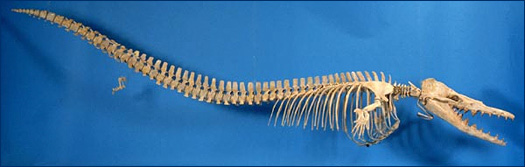
As whales began to swim by undulating the whole body, other changes in the skeleton allowed their limbs to exist used more for steering than for paddling. In the skeletons of living dolphins and whales, the transition from body to tail fluke is marked by a change in their vertebral column: body vertebrae are taller than they are broad, and tail fluke vertebrae are wider than they are alpine. We see the same pattern in fossils from early basilosaurid whales, likeDorudon andBasilosaurus, and and so know that they had flukes that could help power swimming. They also had other skeletal changes that accommodate an aquatic lifestyle. Their elbow joints were flexible, unlike living whales, but able to lock, assuasive the forelimb to serve equally a better control surface and resist the oncoming flow of water every bit the animal propelled itself forward. The hindlimbs of these animals were nearly nonexistent. They were so tiny that many scientists think they served no effective role and may have even been internal to the trunk wall. Occasionally, we discover a living whale with the vestiges of tiny hindlimbs within its body wall.
These vestigial hindlimbs are prove of basilosaurids' terrestrial heritage. The movie below on the left shows the cardinal ankle basic (called astragali) of three artiodactyls, and you can see they take double pulley joints and hooked processes pointing up toward the leg-bones. Below on the right is a photo of the hind human foot of a basilosaurid. Yous tin can see that information technology has a complete ankle and several toe bones, even though information technology can't walk. The basilosaurid astragalus even so has a pulley and a hooked knob pointing upwardly towards the leg bones as in artiodactyls, while other basic in the ankle and foot are fused. From the ear basic to the ankle bones, whales belong with the hippos and other artiodactyls.
Reviewed and updated, June 2020.
Isotopic analyses data from:
Bajpai, S., and P.D. Gingerich. 1998. A new Eocene archaeocete (Mammalia, Cetacea) from India and the time of origin of whales.Proceedings of the National Academy of Sciences 95:15464-15468.
Barrick, R.E., A.G. Fischer, Y. Kolodny, B. Luz, and D. Bohaska. 1992. Cetacean bone oxygen isotopes as proxies for Miocene ocean compostion and glaciation.Palaios 7(5):521-531.
Thewissen, J.G.M., L.J. Roe, J.R. O'Neil, S.T. Hussain, A. Sahni, and S. Bajpai. 1996. Evolution of cetacean osmoregulation.Nature 381:379-380.
Yoshida, N., and N. Miyazaki. 1991. Oxygen isotope correlation of cetacean bone phosphate with ecology water.Journal of Geophysical Research 96(C1):815-820.
Source: https://evolution.berkeley.edu/what-are-evograms/the-evolution-of-whales/

Post a Comment for "what leads paleontologists to hypothesize that whales evolved from wolf-like carnivores?"